
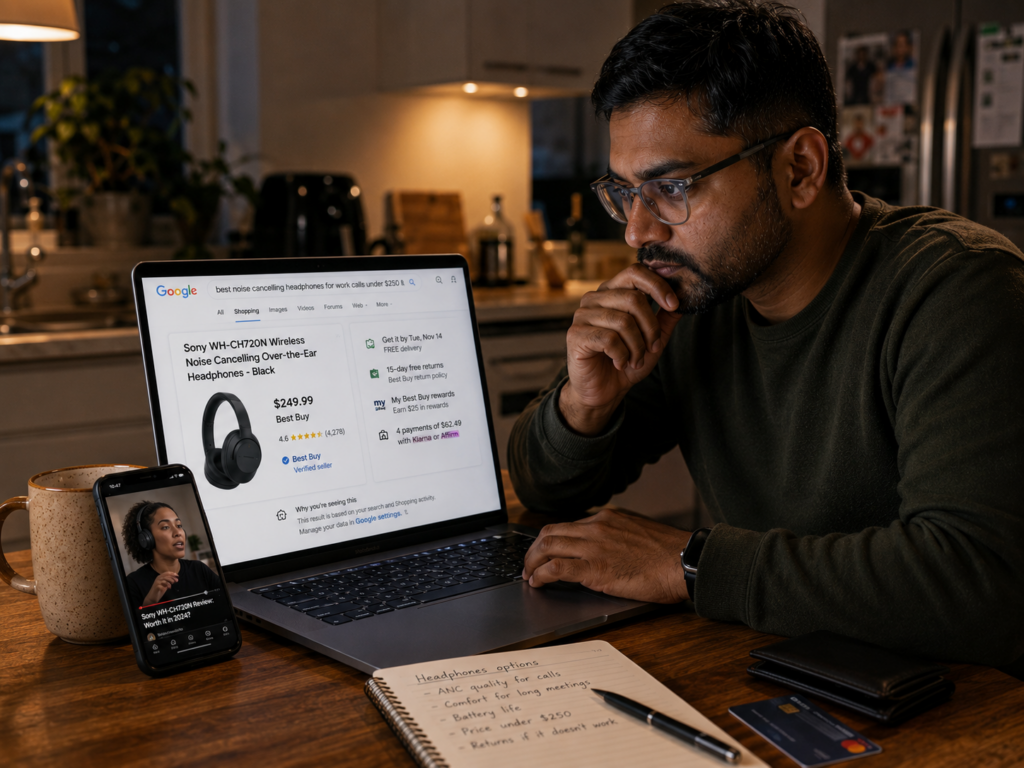
Ecommerce leaders have spent the last few cycles preparing for a world where discovery happens somewhere else. AI assistants, social marketplaces, retail media networks, and payment layers have all started to move closer to the customer’s first decision.
Retailers are already experimenting with AI apps and assistant-based shopping experiences, but the open question is whether those tools can create enough confidence for shoppers to act.
But the more urgent shift this cycle is not another version of “the interface is changing.” It is what that change demands from the offer itself.
When the shopping journey is compressed by AI referrals, agentic search, embedded financing, delivery promises, and platform marketplaces, brands get fewer chances to explain themselves later.
The offer has to prove it is fair, reliable, valuable, and recoverable before the shopper commits.
Why Proof Now Comes First
That is a different kind of ecommerce conversion strategy.
In the old funnel, uncertainty could be managed across multiple moments. A customer might see an ad, visit the site, read a product page, compare shipping, notice a loyalty benefit, check reviews, and then decide whether the brand deserved the order.
Now more of that judgment is happening upstream or all at once.
An AI assistant can shortlist options before the shopper sees the site. Google can blend AI search, ads, commerce agents, checkout, YouTube, and merchant systems into one decision environment. TikTok Shop can turn creator content into an acquisition and purchase layer for small businesses.
The surface may vary, but the pattern is consistent: the brand has less control over the order in which proof appears.
AI Shopping Raises the Standard for Trust
That makes trust a working system, not a brand sentiment.
Consumers using AI to shop still care about basic proof: price, seller recognition, reviews and whether the recommendation feels credible. AI shopping behavior may shorten research, but it does not erase doubt.
In some ways, it raises the standard because shoppers arrive with the expectation that the system has already done some filtering for them.
If the merchant experience then feels slow, inconsistent, opaque or risky, the failure is sharper. AI-referred shoppers may be more likely to return when the experience works, but also more likely to disappear when it doesn’t.
The referral creates borrowed confidence, and the retailer either validates it quickly or burns it.
That’s why customer trust in ecommerce now must be visible before the purchase, not repaired after the disappointment.
Affordability Becomes Part of the Decision Layer
The same logic applies to affordability.
Google’s partnerships with Affirm and Klarna point to a future where financing is not simply a checkout option waiting at the end of the purchase path. It becomes part of agentic commerce decisioning, a way for the system to determine which offer feels buyable in the moment.
That matters because affordability is increasingly part of trust.
A shopper doesn’t only want to know whether the product is right; they want to know whether the price, payment path, rewards, delivery timing and return terms make the decision feel safe.
Ecommerce payment options are no longer just transaction utilities. They’re part of how the shopper evaluates whether the purchase is reasonable right now.
Best Buy’s move to make rewards more visible across product pages, carts, checkout and member hubs reflects the same pressure from another angle.
Loyalty program value must show up where the purchase decision is being made, not after the customer has already done the work.
Fairness and Fulfillment Become Conversion Signals
Pricing fairness is becoming part of that proof as well.
Maryland’s ban on surveillance pricing in grocery stores shows how quickly personalization can move from optimization tactic to trust and governance problem. If customers believe data is being used to charge them more, the issue is no longer whether the offer converts today.
It is whether the business can defend the logic of its pricing tomorrow.
This is especially important in ecommerce because so many growth systems depend on segmentation, dynamic offers, retail media targeting, loyalty data and algorithmic decisioning.
The more invisible the logic, the more damaging it becomes when consumers or regulators decide it feels unfair.
Operational proof is just as important as financial proof.
Same-day delivery is spreading because speed has become a demand-capture tool, but speed only helps when it is believable. An ecommerce delivery promise that fails becomes a trust penalty. A return policy that sounds easy but feels punitive becomes a retention penalty.
A loyalty benefit that exists but is hard to see becomes a wasted conversion signal.
These are not back-office details anymore. They are the evidence shoppers use to decide whether an offer deserves confidence.
Visible Reliability Is the New Growth Discipline
This is why the growth model itself is being tested.
Web-only retailers and consumer brand manufacturers have shown stronger growth patterns when they can combine direct relationships, repeat demand, and clearer channel economics. At the same time, small businesses are finding real volume inside TikTok Shop and other platform environments.
Both signals matter because they show the same tension from opposite directions.
Owned relationships still matter because they preserve data, economics and repeat purchase logic. Platform environments matter because they increasingly create the demand.
The companies that win will not be the ones that pick one side cleanly. They will be the ones that make the proof of value travel across both.
For brand stakeholders, the practical takeaway is that conversion now depends on visible reliability.
The brand cannot assume the shopper will wait for clarification, dig for benefits or forgive friction because the product is good. The system must surface the right proof early: clear price, credible seller, trustworthy reviews, visible rewards, realistic delivery, safe payment options and fair use of data.
This does not mean every brand needs the fastest delivery, richest rewards or broadest financing stack.
It means every brand needs a clear answer to why this offer is safe to buy now.
The next phase of Commerce, Everywhere is not just about being present in more places. Presence is not enough if each surface creates a new opportunity for doubt.
AI search, social commerce, loyalty programs, payments and fulfillment are all becoming part of the same pre-purchase trust layer. The customer may still buy from the brand, but the decision is increasingly shaped by whether the brand can make its value, fairness and reliability obvious before the moment passes.
In this environment, trust is not earned after the transaction. It is the condition that allows the transaction to happen.
The Net Effect
For CEOs
Trust is now a commercial operating constraint.
Leaders need to know where the business is asking shoppers to believe something before it has been proven: that pricing is fair, rewards are worth it, delivery will hold, financing is safe and the experience will recover if something goes wrong.
Those proof points belong in growth strategy, not only in brand strategy.
For CMOs
The message has to match the evidence.
Reviews, seller credibility, loyalty value, payment flexibility, delivery confidence and price transparency should be treated as core conversion assets, not supporting details.
The job is no longer simply to drive shoppers into the funnel; it is to make the offer believable before the shopper decides whether to enter.
For CDOs
The digital mandate is to make trust visible and consistent across every surface where a decision can happen.
Product data, checkout logic, reward visibility, financing options, delivery promises, pricing rules and post-purchase policies need to resolve cleanly across AI referrals, owned commerce, marketplaces and social commerce environments.
References
Retailers are rushing to build AI apps. It’s unclear if shoppers will use them — Modern Retail
AI referrals make shoppers more likely to either return — or never come back — CX Dive
What customers consider when using AI to shop — CX Dive
Google upgrades AI search ads: What marketers need to know — The Verge
Google partners with Affirm, Klarna on BNPL for agentic commerce — Digital Commerce 360
TikTok Shop says sales from U.S. small businesses climbed 66% in 2025 — Modern Retail
Maryland becomes first state to ban surveillance pricing in grocery stores — The Guardian
Ecommerce Trends: Which type of online retailer is growing fastest in the 2020s? — Digital Commerce 360
Why more retailers are offering same-day delivery — Supply Chain Dive
Best Buy adds rewards to its loyalty programs — Retail Brew