

Retail has a familiar planning rhythm. The fourth quarter gets the calendar, the budget, the cross-functional war room, and the post-season measurement. Everything before that often gets treated as a string of smaller moments: a Valentine’s Day campaign, a spring sale, a Mother’s Day gift guide, a graduation email, a Father’s Day promotion, then a Prime Day push.
That is the problem.
From Valentine’s Day through Amazon Prime Day, shoppers move through a dense sequence of relationship-driven gifting, cultural moments, milestone occasions, summer planning, and deal-seeking. The industry may not measure that stretch as one clean market total, but shoppers experience it as a connected series of reasons to buy.
That makes “Celebration Season” less of a slogan than an operating season.
Nomix Group CEO Colin Jeavons recently framed the early May-through-late June stretch, including Mother’s Day, graduation, Father’s Day, and wedding season, as retail’s second major gifting window in Retail Customer Experience’s The celebration season: Retail’s second biggest gifting window is hiding in plain sight. As he put it:
“Commerce does not wait at a destination. It is present wherever the consumer is when the occasion enters their mind.”
A $260 Billion Reason to Plan the Season Differently
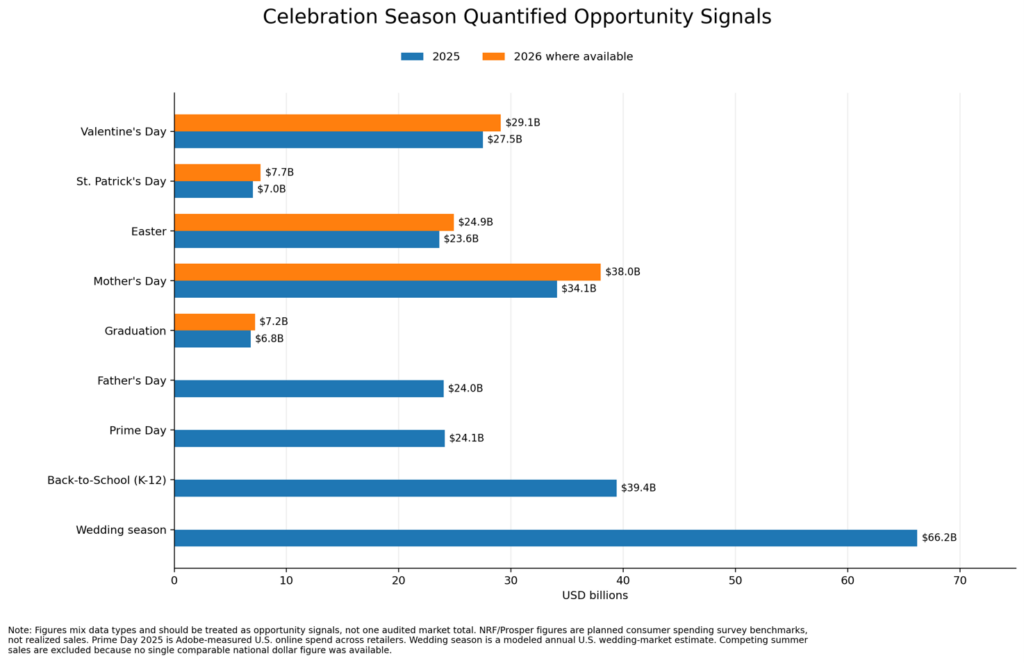
Using 2026 figures where they are available and the latest available 2025 figures where 2026 data has not yet been published, the U.S.-focused Celebration Season opportunity signal totals roughly $260 billion across shopping, gifting, wedding, Prime Day, and Back-to-School benchmarks.
That figure blends public U.S. benchmarks, including National Retail Federation (NRF) x Prosper Insights & Analytics’ planned-spending surveys, Adobe’s measured U.S. online Prime Day spend, and a U.S. wedding-market estimate from The Wedding Report. It should be read as an opportunity signal, not as one audited U.S. retail-sales total. Where the public data allows, the analysis reflects both online and offline spend; Amazon Prime Day is the main online-only exception.
The estimate likely undercounts the full summer sales opportunity because Adobe’s Prime Day benchmark captures online spending across U.S. retailers during the defined event window, but there is no single comparable public national dollar figure for the broader omnichannel sales wave across competing retailers such as Walmart, Target, Best Buy, and Kohl’s.
The exact total matters less than the pattern. Celebration Season contains a repeatable set of high-intent U.S. commerce moments that are too large, too compressed, and too behaviorally connected to manage as a loose string of disconnected campaigns.
How This Compares With the Holiday Season
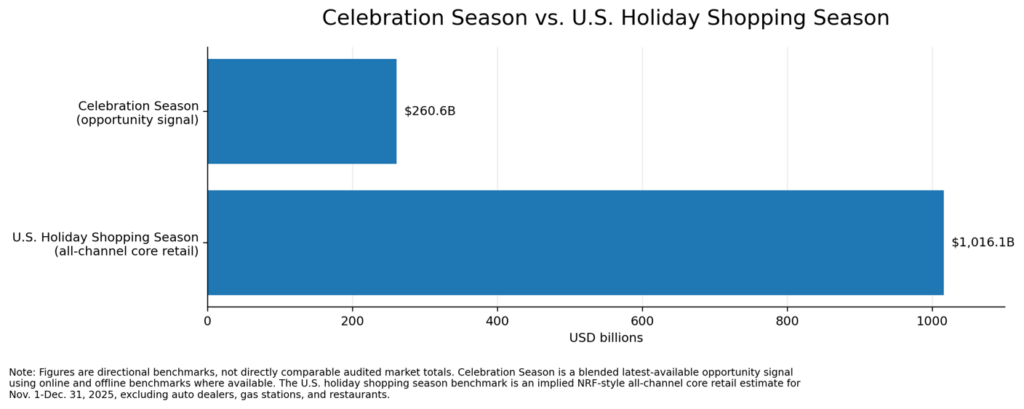
The fairest comparison to the traditional holiday shopping season is the all-channel U.S. holiday retail market, because that benchmark includes both online and offline retail.
On NRF’s November–December retail forecasts, Holiday 2025 was a little over $1 trillion. That puts Celebration Season at roughly one-quarter of the full U.S. online-and-offline holiday retail market. It does not replace Q4, but it is large enough to deserve a connected operating plan of its own.
Celebration Season also sits near the scale of holiday ecommerce: Adobe measured $257.8 billion in U.S. online holiday spend in 2025.
The Connective Tissue Is Shopper Behavior
The reason Celebration Season matters is not simply that the calendar is crowded. It is that the shopper keeps returning to similar questions across different occasions:
Who am I buying for? What does this relationship call for? What feels thoughtful rather than generic? How quickly do I need it? Who can help me choose? Where is the best value?
- Valentine’s Day opens the season with relationship-based gifting.
- St. Patrick’s Day and Easter add cultural, social, family, food, apparel, candy, and hosting moments.
- Mother’s Day expands the emotional stakes.
- Graduation introduces milestone gifting, cash, technology, dorm needs, travel, and first-apartment purchases.
- Wedding season adds registry, travel, fashion, beauty, home, and services.
- Father’s Day extends the late-season gifting pressure.
Then Prime Day and competing summer sales shift the shopper from “what should I buy?” to “where is the best value right now?”
That progression is the arc.
Celebration Season starts with emotional gifting and moves toward milestone spending, summer needs, and deal-seeking. The consumer does not experience those as separate marketing briefs. They experience them as life moving quickly, with a purchase decision attached to each moment.
Discovery Starts Before the Retailer Site
In this season, the retailer’s site is often not where demand begins. It is where demand resolves. Shoppers look for ideas, validation, social proof, and value before they land on a product page.
That discovery path now runs across search, social feeds, creator content, publisher gift guides, marketplaces, email, retail media, affiliate links, and AI-assisted recommendations. This matters because Celebration Season decisions are often recipient-specific and time-sensitive. The shopper is not only browsing. They are trying to make a good decision for a specific person or occasion, often under a deadline.
That is why publishers, creators, affiliates, and other commerce partners are not side channels in this window. They are part of how the shopper decides. A gift guide can reduce uncertainty. A creator can make a product feel relevant. A publisher comparison can validate the choice. A deal partner can help the shopper act before the deadline.
In a season built around trust, relevance, and timing, outcome-based commerce is not just a media tactic. It is infrastructure.
Prime Day Should Close the Season, Not Define It
Prime Day is a powerful endpoint, but it should not swallow the story. In 2026, Amazon moved Prime Day to June 23 through June 26, which places it directly at the end of the Valentine’s Day-through-Prime-Day arc. That timing strengthens the case for treating the months before it as a connected season.
The Prime Day close changes the shopper’s mindset. Earlier in the season, the dominant need is often relationship and occasion fit. By late June, the need is increasing in value, comparison, and timing. Summer deals, early Back-to-School pull-forward, travel, home, outdoor, and everyday essentials all enter the frame.
For retailers and brands, that means the season should not end with a Father’s Day email and then restart with a Prime Day deals page. The transition should be planned. A Celebration Season hub can move from gifts by relationship to gifts by milestone, then into summer deals, early school needs, and best-value guides. The customer journey changes, but the system should remain connected.
What Connected Planning Looks Like
Planning Celebration Season as one commerce arc is not abstract. It means building the reusable system once, then updating it as the shopper moves through the season.
For retailers, that could mean one seasonal hub that evolves from Valentine’s Day through Prime Day. The navigation should help shoppers browse by recipient, relationship, moment, budget, timing, and shipping need. A gift finder should not be rebuilt for every holiday. It should change inputs as the season changes: partner, friend, parent, graduate, teacher, host, couple, dad, or deal seeker. Shipping clarity, last-minute options, gift cards, pickup, and digital delivery should be visible when deadlines are tight.
For brands, connected planning means a creative platform that can flex across moments. A message about celebrating the people, moments, and milestones that matter can become Valentine’s Day relationship gifting, Mother’s Day care and gratitude, graduation’s next chapter, wedding season’s shared celebration, Father’s Day interests and hobbies, and Prime Day’s smart summer buy. The idea stays consistent while the shopper context changes.
For publishers, Celebration Season should be treated as an editorial commerce franchise. Instead of publishing a single Mother’s Day guide and moving on, a publisher can build a recurring package: Valentine’s gifts by relationship, spring hosting picks, Mother’s Day gifts by recipient, graduation gifts by life stage, wedding guest and registry guides, Father’s Day gifts by interest, Prime Day deal watchlists, and non-Amazon summer deal comparisons. That approach gives content teams a reason to update, recirculate, and monetize the same seasonal architecture over months.
For commerce partners, the practical work is an offer and partner map. Which merchants have offers tied to each moment? Which publishers are best suited to gift guides, comparisons, or deal coverage? Which creators match the category? Which categories spike by moment? Which KPIs will show whether the season is working? The answer should not live in five disconnected spreadsheets.
The Net Effect
The net effect is simple: Celebration Season is not just a content calendar exercise. It is a commerce operating model for a period when shoppers repeatedly need ideas, confidence, convenience, and value.
That model should include a shared calendar, reusable landing pages, recurring gift-guide templates, a partner activation plan, an offer calendar, and season-level measurement. Track traffic by moment, click-through rate, conversion rate, average order value, partner revenue, publisher contribution, creator contribution, offer engagement, and Prime Day halo effects.
The goal is to see the arc, not just the isolated spikes.
Q4 will remain retail’s biggest season. But the industry already knows how to plan for Q4. The Celebration Season is different. It is measurable in parts, messy in public data, and powerful in shopper behavior. It runs on relationships, deadlines, milestones, trust, and value. That makes it exactly the kind of season that benefits from connected commerce planning.
Celebration Season is already on the calendar. What most retailers are missing is the strategy that connects it.