
The Industry Is Aligned. That’s Not the Problem.
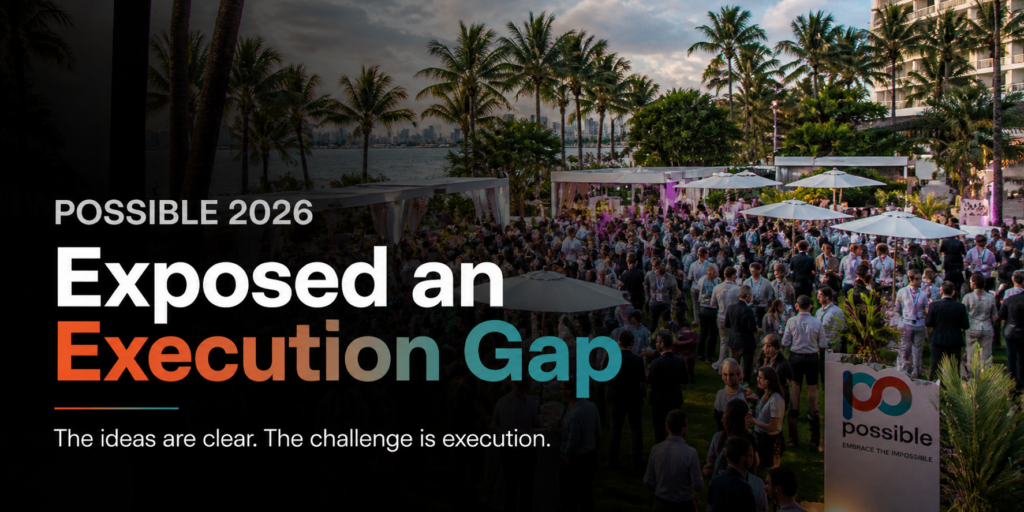
The ad industry isn’t short on ideas. It is short on the ability to execute them. That was abundantly clear quickly during the annual POSSIBLE confab in Miami. The event’s official LinkedIn account described the week as “packed rooms” and “nonstop conversations,” which matched the reality on the ground. The rooms were full. The meetings ran continuously.
What stood out wasn’t the energy. It was how familiar everything sounded.
AI is embedded in workflows. Retail media continues to expand. Creator-driven environments are shaping discovery. Measurement is still lagging behind all of it. None of that is new, and no one is debating it anymore.
In an interview with The Drum, POSSIBLE co-founder Christian Muche said, “That’s not a conversation. It’s about translating it into specific tasks and opportunities for marketers.”
Because the gap isn’t understanding. It’s translation. Panels stayed at the idea level, but real conversations moved immediately into execution: how to use these systems, how to scale them, and how to measure them when the path to purchase is no longer predictable.
Fragmentation Is the Norm
Fragmentation came up repeatedly at POSSIBLE. In AdExchanger, Horizon Media’s Domenic Venuto described it directly: “Fragmentation is a real issue.”
Fragmentation isn’t temporary. It is how the system operates.
Discovery starts in AI-generated answers, moves through creator content, shows up in retail media environments and spreads across platforms that weren’t part of the funnel a few years ago. But conversion hasn’t moved with it.
The systems influencing decisions and the systems capturing transactions are now separate. That disconnect is what keeps breaking measurement and forcing teams to revisit attribution again and again.
Colin Jeavons made the same point in his POSSIBLE conversation with Dylan Conroy on The Ad Podcast. The old discovery model is already giving way to a more distributed, agentic environment.
“We’re not necessarily going to deal with the old model of going to a browser, opening it up, getting a bunch of blue links, and clicking, clicking, clicking. That model is evolving very rapidly.”
That is the Commerce, Everywhere problem in plain language. Discovery is no longer confined to a browser, a marketplace, a retail shelf or a brand’s owned site. The path is spreading across AI interfaces, creator environments, publisher content, retail media, search, social commerce and performance media. Now the operating model needs to catch up.
This Is an Operating Problem, Not a Channel Problem
Most organizations still treat this like a channel problem.
Just adding platforms, formats and tools misses the point. The pressure is happening across three connected areas at once: creative demand is increasing faster than teams can produce, distribution is fragmenting faster than teams can coordinate and measurement is lagging behind both.
Handled separately, each problem is manageable. Together, they require a different way of operating. That’s a shift most teams haven’t made yet.
POSSIBLE 2026 Perspectives
Nomix Group came into POSSIBLE with a clear point of view. Commerce is no longer a destination, it’s distributed. Discovery is happening before a user reaches a site, and influence is happening in environments brands don’t control. That’s already how the system behaves.
At POSSIBLE, that position felt aligned with what people are experiencing. What was less clear was how to operate inside that reality.
In Todd Ulise’s Commerce, Everywhere talk on the Innovation Stage, the focus was on how the storefront is changing and identity is becoming less reliable as an intent signal. Instead, intent is showing up in environments that don’t map cleanly to traditional targeting systems.
You could hear the gap in real conversations. As soon as discussions moved past ideas, they moved into constraints: how to produce enough creative, how to test at the pace platforms require and how to measure performance when influence and conversion are disconnected.
Commerce, Everywhere isn’t just a marketing tagline, it’s an operating requirement. Faster creative, faster adaptation and faster activation where purchase intent now appears is imperative.
Watch the Commerce, Everywhere video produced with Fanomix AI content creation technology.
Execution Is the Only Remaining Lever
Statements like “Speed isn’t optional; it’s foundational” and “The era of ‘set and forget’ marketing is over, ” showed up across recaps, including Doceree’s.
They are not general observations. They are requirements.
Campaigns are not static. Creative is not fixed. Discovery is not predictable. The advantage comes down to whether a team can operate consistently inside that system.
Jeavons put the execution challenge more directly:
“The key is speed. This is a very, very rapidly changing market.”
That speed is not only about launching campaigns faster. It is about shortening the distance between signal, creative, distribution, measurement and optimization. When discovery is fragmented, the team that can move from intent to activation faster has the advantage.
The creative layer is part of that shift. Jeavons described AI as a way to remove slow, expensive production steps so marketers can focus on the human creative work that makes the message matter. In one example, he described changing a car ad from a desert setting to snowy mountains and localizing it into 12 languages in less than two hours.
That kind of speed changes what performance, personalization and creative testing can mean.
The Net Effect
The industry is not constrained by ideas. It is constrained by execution. POSSIBLE made that clear. Fragmentation is now the baseline, speed is now the advantage and commerce is no longer waiting for consumers to arrive at a fixed destination.
The teams that win will be the ones that can operate inside the system as it exists: acting wherever intent appears, creating fast enough to stay relevant and measuring performance across paths that no longer move in a straight line.