
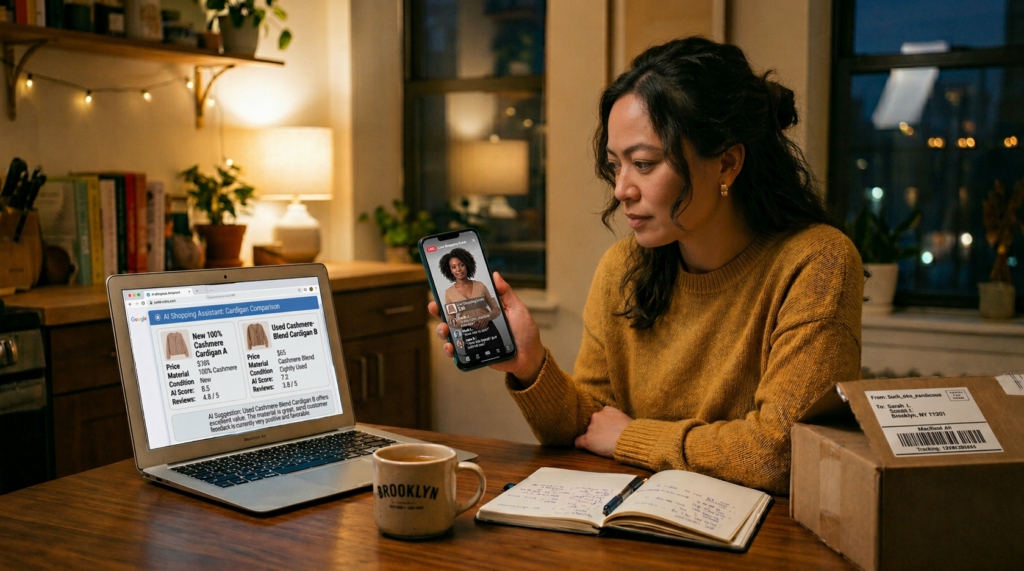
For years, digital commerce strategy assumed that the hard part was getting a shopper to your front door. You fought for the search result, the social click, the email open, or the paid impression, and once the shopper landed on your site, the rest of the job was yours.
That assumption is starting to break.
The most important shift in this cycle is not simply that discovery is moving beyond the homepage. It is that distributed discovery is beginning to produce measurable growth in places that used to be treated as assistive, experimental, or upper funnel.
That is a more consequential change than it sounds.
Commerce leaders have already spent enough time debating whether AI assistants, social platforms, and alternative marketplaces might influence shopping behavior. The live question now is whether those surfaces are becoming commercially meaningful enough to reshape growth planning. The strongest evidence says yes.
Adobe’s latest analysis found that AI-driven traffic to U.S. retail sites rose 393% in the first quarter of 2026 versus a year earlier. More importantly, that traffic is not just arriving in larger volumes. It is converting better, generating higher revenue per visit, and engaging more deeply once it lands.
AI Referral Traffic Is Becoming a Growth Signal
That matters because it changes how leaders should interpret the role of non-owned commerce channels. AI referral traffic used to look like an interesting edge case. Now it looks more like an early signal of where high-intent demand may increasingly originate.
Adobe found that AI-driven visits converted 42% better than non-AI traffic in March, with 37% higher revenue per visit, 12% higher engagement, and significantly longer time spent on site. That does not mean the homepage is irrelevant. It means the homepage is no longer the sole or even primary proving ground for demand creation. Increasingly, it is the place where demand arrives after being shaped somewhere else.
That shift matters for more than traffic analysis. It changes digital commerce acquisition strategy. If AI product discovery is doing more of the filtering, ranking, and shortlisting before a shopper ever lands on the site, then owned properties are receiving demand that has already been partially formed. The site still matters, but more of the commercial work is being done upstream.
Social Commerce Conversion Is Getting Operational
TikTok Shop shows the same shift from a different angle.
For a while, social commerce could be dismissed as a channel that worked mainly for digitally native brands, impulse products, or creator-led bursts. That explanation is getting weaker.
Modern Retail reports that sales from brands with at least $30 million in annual revenue rose 97% year over year on TikTok Shop, while the platform logged more than 103 billion U.S. searches with ecommerce intent in 2025 and saw total transaction volume rise nearly 80%.
Ulta and Sally Beauty joining the platform is significant not because they are famous brands, but because their presence signals a broader belief that the channel now deserves operational attention, not just campaign experimentation.
The deeper signal is organizational, not promotional.
Larger brands are increasingly treating TikTok Shop the way brands once learned to treat Amazon: as a channel that needs its own operating muscle, its own inventory logic, its own creator strategy, and its own accountability. The platform’s creator network is part of that maturation. TikTok Shop says the number of creators earning commissions rose 146% year over year, helping turn creator content into a more dependable transaction layer for larger sellers.
In other words, the channel is no longer just where attention happens. It is becoming a place where discovery, persuasion, and purchase can collapse into the same surface. That is what makes social commerce conversion a strategic issue rather than a niche marketing story.
Resale Customer Acquisition Is Expanding the Demand Perimeter
Resale extends the argument further, and in a way that many operators still underrate. Retail Brew reports that 84% of U.S. resale shoppers use the channel to discover new brands, and that 58% later go on to buy new items from those same brands.
That changes how resale should be understood.
It is not only a circular-commerce story or a price-sensitivity story. It is also a resale customer acquisition story. For premium and higher-price-point brands especially, resale is becoming a lower-friction entry point that lets shoppers experiment with a label before they commit to buying firsthand.
The first touch may now happen in a secondary market, but the commercial value can still flow back to the primary brand. That matters because it expands the brand’s demand perimeter. Discovery is no longer confined to search, social, marketplaces, or owned media. It can now begin in channels many brands still treat as adjacent to the real business.
Distributed Commerce Strategy Means Managing More Than Owned Sites
Put these three signals together and the franchise move becomes clearer. Commerce is not just showing up in more places online. Those places are increasingly doing more of the commercial work.
- AI assistants are pre-qualifying intent before traffic reaches the site.
- TikTok Shop is making creator-led discovery operational enough to support larger retailers.
- Resale is functioning as a brand-discovery engine that can lower acquisition costs and widen entry points.
The strategic commonality is not that new channels matter. It is that non-homepage surfaces are starting to behave like real growth infrastructure.
That raises a harder question than most organizations are prepared for. If meaningful growth is increasingly born outside owned properties, then performance can no longer be managed as a simple contest between media spend and onsite conversion rate.
The new job is to make the business legible and compelling across distributed surfaces that each have their own logic. That is the real work of a distributed commerce strategy.
AI systems need clean, accessible product information and trustworthy site architecture. Social commerce platforms need inventory, merchandising, and creator operations that can hold up under transaction pressure. Resale ecosystems need to be understood not as leakage, but as part of the brand’s demand perimeter.
The companies that win will be the ones that stop treating these surfaces as exceptions and start managing them as an interconnected portfolio of acquisition environments.
Non-Owned Commerce Channels Are Changing What Commerce, Everywhere Means
This is where Commerce, Everywhere actually sharpens.
The everywhere is not just a proliferation of touchpoints. It is the redistribution of commercial influence into systems, feeds, marketplaces, creator ecosystems, and secondary channels that shape demand before the brand ever gets to perform its usual conversion playbook.
The old instinct was to ask how to pull shoppers back to the homepage. The more useful question now is how to make growth travel well across environments you do not fully own but can no longer afford to treat as peripheral.
In this cycle, the big change is that distributed discovery is no longer merely where interest begins. It is increasingly where revenue starts.
The Net Effect
For CEOs
Growth strategy now must account for acquisition happening in places that sit outside the traditional owned-funnel model.
The issue is no longer whether these surfaces matter. It is whether the organization is structured to capture value from them before competitors do.
For CMOs
Discovery is becoming more distributed and more transactional at the same time.
That means brand, performance, creator strategy, and merchandising can no longer be managed as separate disciplines if the highest-intent demand is being formed before shoppers ever reach the site.
For CDOs
The technical mandate is to make the business portable across AI, social commerce, and alternative discovery surfaces.
Clean product data, strong content accessibility, inventory reliability, and channel-specific operations are becoming prerequisites for growth, not back-end optimizations.
References
AI traffic to US retailers rose 393% in Q1, and it’s boosting their revenue too — TechCrunch
More than 8 in 10 shop resale to discover new brands — Retail Brew
Sales from major brands on TikTok Shop nearly doubled in 2025, drawing Ulta and Sally Beauty — Modern Retail