
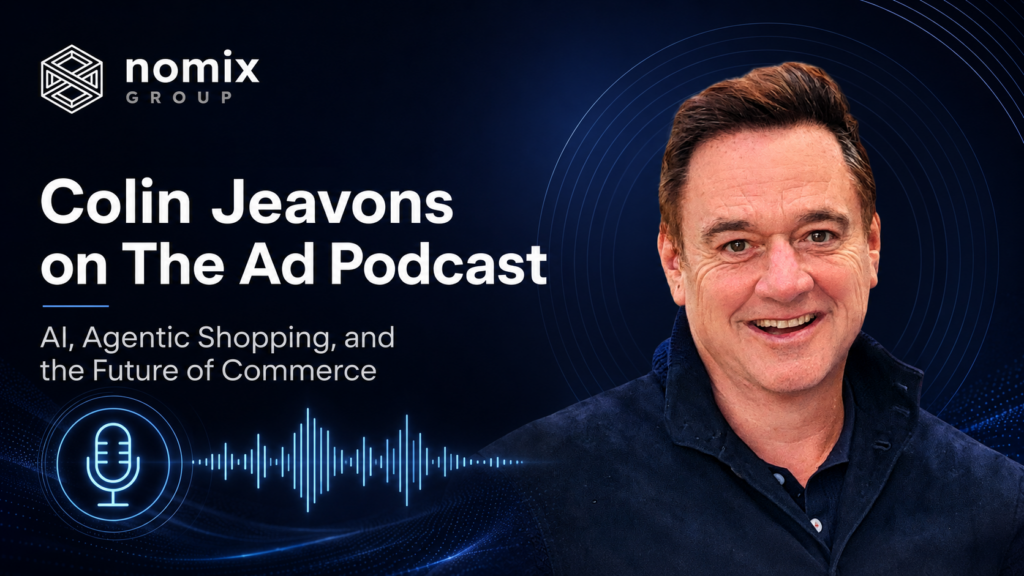
Colin Jeavons joined Dylan Conroy, host of The Ad Podcast, at POSSIBLE 2026 for a conversation about how AI is changing commerce, creative production, and the way brands earn consumer attention.
The discussion moves across agentic shopping, AI-generated video, creator-led influence, and the growing need for brands to respond faster to the moments and channels that shape buying behavior.
Listen to the Conversation
Prefer audio? Listen on Apple Podcasts or Spotify.
Three Key Takeaways
1. Agentic Shopping Changes Where Product Decisions Happen
Jeavons describes a future where consumers may not always begin their shopping journey with a browser, search box, or familiar list of blue links. Instead, AI agents, connected devices, and automated replenishment systems may increasingly help decide which products are surfaced, compared, or reordered.
For brands, that shift changes the work of ecommerce marketing. The goal is not only to win attention after someone starts searching. It is also to become visible, trusted, and actionable inside the systems that may shape product choice before a shopper actively looks.
2. Creative Speed Is Becoming a Commerce Advantage
The conversation also points to a major operational change: AI can compress the time and cost required to create relevant commerce creative. Jeavons describes a world where brands can move from a timely cultural moment to personalized, channel-ready creative much faster than traditional production models allow.
That does not make creative strategy less important. It makes the gap between idea and execution more important. When brands can respond to cultural moments, product context, audience signals, and channel needs faster, creative becomes a performance lever as well as a brand asset.
3. Creators and Podcasts Are Becoming Commerce Influence Channels
Jeavons also connects AI commerce to the creator economy. The conversation frames creators, podcasters, and expert voices as part of a broader media environment where people spend time learning, forming opinions, and deciding who to trust.
For brands, that makes creator partnerships more than an awareness play. In categories where explanation, trust, expertise, or loyalty matters, creators can help bridge the gap between product information and purchase confidence.
Why It Matters for Brands
The practical thread running through the episode is speed with relevance. Brands will need clearer product data, faster creative workflows, stronger creator and publisher relationships, and better ways to connect trusted influence to conversion.
The next phase of commerce will not be defined by automation alone. It will be defined by how well brands combine automation with creative judgment, product clarity, and the ability to show up in the moments that shape demand.
Full Transcript
Transcript lightly edited for clarity, readability, and speaker attribution.
Speakers: Dylan Conroy, host of The Ad Podcast; Colin Jeavons, Founder, CEO and Chairman of Nomix Group.
Colin Jeavons:
What I love about AI is that it actually enhances the human gift of creativity. You can take away production components that are extremely time-consuming or expensive, and focus on the creative genius of the human. You can use these technologies to get better performance and do things that are more fun.
Dylan Conroy:
Good morning, everybody. Welcome back to The Ad Podcast here at POSSIBLE in beautiful Miami. It is day one. We are here with Colin Jeavons, CEO and chairman of Nomix Group. Colin, thanks for coming on. Great to see you. Tell us a little bit about yourself, Nomix Group, and what brought you to POSSIBLE this week.
Colin Jeavons:
Briefly, I have spent 30 years in the search technology space, and I have also been in AI, machine learning, and natural language processing since around 2008, before it was trendy. Back then, most people thought you were talking double Dutch when you talked about machine learning, IBM Watson, and things like that.
Colin Jeavons:
We created a big company in the defense space, and that company is still in the defense space. We have been through the whole evolution of what you see now with ChatGPT, Perplexity, and similar technologies. We have a long background in the core technologies.
Colin Jeavons:
We started Nomix Group three years ago because the reality of shopping is going to radically change. Agents are going to shop on behalf of their owners, and consumers are going to have their own agents. You and I are not necessarily going to deal with the old model of opening a browser, getting a bunch of blue links, and clicking through. That model is evolving very rapidly.
Colin Jeavons:
We created Nomix Group to help three constituents. First, consumers want the right product, in the right place, at the right time, and at the right price. Not everyone wants the same thing. Some people want something instantly. Some are willing to wait. There are no rights or wrongs. It is individuality.
Colin Jeavons:
The second constituent is merchants. Retail and ecommerce are highly competitive. The third is the technology partners looking to connect those two groups, whether they are publishers, technology partners, phone manufacturers, or others.
Colin Jeavons:
Nomix Group was built to help those constituents. We have an AI video creation tool that creates video at high scale across millions of products in less than 10 minutes. It gives marketers the ability to have just-in-time creative. If you are watching the Super Bowl and want to put out a great advertisement across social media 20 minutes later, that changes what is possible.
Colin Jeavons:
It also changes media buying. Instead of using traditional TV ad formats in places like Meta, brands can create things meant for the channel and personalized to the individual. You have creative relevance, contextual relevance, profile relevance, and the call to action for conversion. From a brand marketer perspective, it is the possibility of conversion and branding together. For conversion teams, it can be a significant multiplier because the story can be directed to the person.
Colin Jeavons:
My wife recently saw an ad on Facebook with my son’s face in a dinosaur world. It said, click this button and we will generate a unique AI-derived book about Tristan and the dinosaur world. She immediately wanted it. That is going to change marketing. Think about elections and other categories. I have been in this space since the late 1990s, and I think 2026 is going to be one of the biggest changes we have seen.
Dylan Conroy:
You mentioned the agentic shopping movement. I listen to a lot of keynotes throughout the years. Most of them are rubbish, as you probably know. But Zach, who was the original go-to-market person for ChatGPT and OpenAI, got my attention at IAB in Palm Desert this year.
Dylan Conroy:
He talked about AI agents, and also about connected or smart devices. Five or 10 years ago, every device at CES was going to be connected to the internet, but the connectivity component felt early. Why do I need my refrigerator connected to the internet? Why do I need my toaster connected to the internet?
Dylan Conroy:
His prediction was that Samsung will have a different type of retail media network coming up, and that refrigerators with cameras could reorder things as people use them. His point was that there may be only a handful of brands consumers truly care about in their refrigerator or pantry. The rest are commodities, as long as they show up, are good quality, and are competitively priced.
Dylan Conroy:
What does that mean for brands? How do they optimize for AI replenishment or agent replenishment as this starts to come online?
Colin Jeavons:
It is a very complex question. If you are protecting market share, you have to work very fast. For brands looking to gain the authority to become one of those preferred brands, it may be one of the greatest opportunities we have seen. The key is speed. This is a very rapidly changing market, so if you are a brand and you are not using the programmatic benefits of agents, you need to get on the track.
Colin Jeavons:
Think of it from another perspective. If you are the digital marketing director of a multinational brand working across geographies, you are spending hundreds of millions or even billions of dollars in a very complex world. Agents could potentially save hundreds of millions of dollars.
Colin Jeavons:
That money then has to be used by agents for the right creative at the right speed and to identify the right channels. I think the creator channel is going to be very big in the next 18 months. People already think it is big with the sponsorship model, but I think it becomes the connection between sight, sound, motion, high-speed creativity, and the ability to target correctly.
Colin Jeavons:
That creates opportunity. If you are a brand looking to break a monopoly or challenge the big players in your category, there is huge opportunity. If you are one of the big players, you can use the technology to lower costs and put more money into marketing or media. But if you are six months too late, that becomes a problem. You have to use the technology, and you have to use it fast.
Dylan Conroy:
You mentioned creators. A lot of marketers are saying creators represent a major part of their spend now, but it slices many different ways. It is creative, media, audience, experiential, focus group, affiliate. It has a lot of different levers.
Dylan Conroy:
Are you thinking about creators licensing their name and image to digital twin companies like HeyGen or similar tools, where a creator can record 30 to 60 seconds in a studio and creative can then be made in their image and likeness in real time at scale?
Colin Jeavons:
There are a lot of models that have not matured yet. But if you take the history of marketing to its simplest form, marketing has one core purpose: brands want to sell their products to consumers.
Colin Jeavons:
The average consumer is spending significant time in a creator universe. It used to be TV. TV once represented a large share of global marketing spend. The reality is that attention is now in creative hands and in the creator universe.
Colin Jeavons:
We are at the beginning of that model, even though people think platforms like Facebook have been around for a long time. The way performance will be used, the way just-in-time creative will be used, and the way targeting connects to it are all going to keep evolving.
Colin Jeavons:
A lot of this comes down to how AI technology helps you solve problems. If you are a marketer and want to create a car ad, a year ago you might go into the desert, create fire, shoot the car driving through it, and spend half a million dollars. We worked with a car manufacturer recently and did something in less than two hours. You could hit a button and move the car from the desert to snowy mountains, and it was in 12 languages.
Dylan Conroy:
That is wild.
Colin Jeavons:
I would not even tell you the cost, but it was a fraction.
Dylan Conroy:
That allows more challenger brands to compete if everyone has access to the same creative firepower.
Colin Jeavons:
What I love about AI is that everyone talks about job loss, and people ask how it will impact the job market or what they should recommend their children become. But AI can actually enhance the human gift of creativity.
Colin Jeavons:
You can take away the production components that are extremely time-consuming or expensive, and focus on the creative genius of the human. You can use these technologies to get better performance and do things that are more fun.
Colin Jeavons:
I remember watching the Super Bowl at halftime and thinking that if I were a phone manufacturer, my ad would be out immediately. You need it just in time.
Dylan Conroy:
A week later, it is not the same. It is like the Oreo dunk-in-the-dark moment, back when you could do it with a tweet. That is also great for people consuming media because creativity is suddenly on fire.
Dylan Conroy:
I wanted to ask you about the creator component. People are spending time in the creator economy. I may see things in-feed during the day, but when I am on the couch in the evening, instead of turning on CNN or Fox News, I may go to two or three podcasts.
Dylan Conroy:
Do you put creators and podcasters in the same bucket? Is the medium interchangeable, whether someone is a podcast creator, a short-form video creator on Instagram, or something else?
Colin Jeavons:
Yes, I think you have to categorize them in the same bucket. There has clearly been an explosion in podcasting, and rightly so. It is video-first now. Podcasting originally disrupted radio. Now it is disrupting nightly television. You can get access to people you could never get access to before, sometimes providing insights you never thought you could get.
Colin Jeavons:
I bucket all of that together. Whether you are scrolling through a social media feed, watching products move through TikTok Shop, or consuming content for knowledge, it all sits inside this broader creator environment.
Colin Jeavons:
Where podcasting has found its gift is that many people consuming that channel are there for knowledge. That makes them an extremely attractive audience for marketers because they are opinion formers and genuine influencers.
Colin Jeavons:
People buy from creators and experts out of loyalty. I remember watching Jocko Willink, one of the Navy SEALs guys. At first I thought, this guy is cool. He kept giving information and value. Eventually you think, fine, I will buy the protein powder. More value, and maybe you buy the jiu-jitsu gi or go to the conference. People step up the buy scale. They call it support. You are supporting someone who gives you information by buying products they make or partner with brands to promote.
Colin Jeavons:
A lot of them do not sell their soul. When someone is seriously into a product category, they know the ins and outs, the pros and cons, and they can recommend something because they believe it is genuinely the best product. That is a real endorsement. If you think you might need it, it gives you the edge to want to purchase it.
Colin Jeavons:
That is different from the old model of seeing an ad in a newspaper or an advertorial. It is different when people are talking about serious topics, giving their views and opinions, and feeling strongly about telling the truth.
Dylan Conroy:
It is a pretty awesome time. Colin, if folks want to follow along with your thinking or connect with you at Nomix Group, where would you like to send the audience?
Colin Jeavons:
By all means, look at us at shopnomix.com. We have multiple brands and are happy to answer questions if people reach out.
Dylan Conroy:
We will put it in the show notes. Thank you, sir. Have a great POSSIBLE.
Colin Jeavons:
Thank you very much. Cheers.